


September 2026 to June 2027
Polish Leaving Cert Academy
Preparing for the Polish exam becomes easier when the whole year has a clear structure. Academy combines a live Monday class, a Saturday grammar workshop, research-informed platform work and monthly individual guidance. The first cohort is formed. The calendar below shows how the current Academy year is structured and what a future group would involve.
The first 2026/27 Academy cohort is now formed. Further groups may open according to demand.
Join the Academy waiting list- September 2026: 7 sessions
- October 2026: 7 sessions
- November 2026: 9 sessions
- December 2026: 6 sessions
- January 2027: 6 sessions
- February 2027: 6 sessions
- March 2027: 6 sessions
- April 2027: 7 sessions
- May 2027: 7 sessions
- June 2027: 4 sessions
65 live sessions across ten months: 34 Monday lessons and 31 Saturday workshops. The short columns are the school breaks.
The commitment
What a week actually looks like
Two fixed live appointments shape the week: Monday exam-skills teaching and Saturday grammar development. A monthly 30-minute individual session is booked separately, and the group works through an exam paper together once a month.
-
Monday Every week
Reading and writing
The exam skills that carry the most marks. Comprehension technique, essay structure and the vocabulary you need to write with confidence.
-
Saturday Every week
Grammar workshop
Two hours to work through the grammar that decides your grade, in a small group, with time to ask about the parts that never quite clicked.
-
Monthly 30-minute session, booked separately Once a month
Individual 1:1 guidance
A private 30-minute session once a month, scheduled separately. Use it to discuss a recurring language problem, review written work or clarify the part of the exam creating the most difficulty.
-
Saturday Once a month
Exam paper review
One Saturday a month the group sits a real past paper together and marks it against the official scheme, so you learn where the marks actually go.
That is of live group teaching in an ordinary week, plus your monthly one to one and the monthly paper review. Every session is recorded, so a missed Saturday is not a lost one.
The 2026/27 year
Every session date, published
The full academy calendar, from to . Nothing is hidden until you pay: the breaks are in here too.
| Month | 1 | 2 | 3 | 4 | 5 | 6 | 7 | 8 | 9 | 10 | 11 | 12 | 13 | 14 | 15 | 16 | 17 | 18 | 19 | 20 | 21 | 22 | 23 | 24 | 25 | 26 | 27 | 28 | 29 | 30 | 31 |
|---|---|---|---|---|---|---|---|---|---|---|---|---|---|---|---|---|---|---|---|---|---|---|---|---|---|---|---|---|---|---|---|
| September 2026 | 7 September: Reading and writing | 12 September: Grammar workshop | 14 September: Reading and writing | 19 September: Grammar workshop | 21 September: Reading and writing | 26 September: Grammar workshop, Exam paper review | 28 September: Reading and writing | ||||||||||||||||||||||||
| October 2026 | 3 October: Grammar workshop | 5 October: Reading and writing | 10 October: Grammar workshop | 12 October: Reading and writing | 17 October: Grammar workshop | 19 October: Reading and writing | 24 October: Grammar workshop, Exam paper review | 26 October: Halloween mid-term | 27 October: Halloween mid-term | 28 October: Halloween mid-term | 29 October: Halloween mid-term | 30 October: Halloween mid-term | 31 October: Halloween mid-term | ||||||||||||||||||
| November 2026 | 1 November: Halloween mid-term | 2 November: Reading and writing | 7 November: Grammar workshop | 9 November: Reading and writing | 14 November: Grammar workshop | 16 November: Reading and writing | 21 November: Grammar workshop | 23 November: Reading and writing | 28 November: Grammar workshop, Exam paper review | 30 November: Reading and writing | |||||||||||||||||||||
| December 2026 | 5 December: Grammar workshop | 7 December: Reading and writing | 12 December: Grammar workshop | 14 December: Reading and writing | 19 December: Grammar workshop, Exam paper review | 21 December: Reading and writing | 22 December: Christmas break | 23 December: Christmas break | 24 December: Christmas break | 25 December: Christmas break | 26 December: Christmas break | 27 December: Christmas break | 28 December: Christmas break | 29 December: Christmas break | 30 December: Christmas break | 31 December: Christmas break | |||||||||||||||
| January 2027 | 1 January: Christmas break | 2 January: Christmas break | 3 January: Christmas break | 4 January: Christmas break | 5 January: Christmas break | 6 January: Christmas break | 7 January: Christmas break | 8 January: Christmas break | 9 January: Grammar workshop | 11 January: Reading and writing | 16 January: Grammar workshop | 18 January: Reading and writing | 23 January: Grammar workshop, Exam paper review | 25 January: Reading and writing | 30 January: No sessions | 31 January: No sessions | |||||||||||||||
| February 2027 | 1 February: No sessions | 6 February: Grammar workshop | 8 February: Reading and writing | 13 February: Grammar workshop | 15 February: Reading and writing | 20 February: Grammar workshop, Exam paper review | 22 February: Reading and writing | 27 February: No sessions | 28 February: No sessions | ||||||||||||||||||||||
| March 2027 | 1 March: Reading and writing | 6 March: Grammar workshop | 8 March: Reading and writing | 13 March: Grammar workshop | 15 March: Reading and writing | 20 March: Grammar workshop, Exam paper review | 22 March: Easter break | 23 March: Easter break | 24 March: Easter break | 25 March: Easter break | 26 March: Easter break | 27 March: Easter break | 28 March: Easter break | 29 March: Easter break | 30 March: Easter break | 31 March: Easter break | |||||||||||||||
| April 2027 | 1 April: Easter break | 2 April: Easter break | 3 April: Easter break | 4 April: Easter break | 5 April: Reading and writing | 10 April: Grammar workshop | 12 April: Reading and writing | 17 April: Grammar workshop | 19 April: Reading and writing | 24 April: Grammar workshop, Exam paper review | 26 April: Reading and writing | ||||||||||||||||||||
| May 2027 | 1 May: May bank holiday weekend | 2 May: May bank holiday weekend | 3 May: May bank holiday weekend | 8 May: Grammar workshop | 10 May: Reading and writing | 15 May: Grammar workshop | 17 May: Reading and writing | 22 May: Grammar workshop, Exam paper review | 24 May: Reading and writing | 29 May: No sessions | 30 May: No sessions | 31 May: Reading and writing | |||||||||||||||||||
| June 2027 | 5 June: Grammar workshop | 7 June: Reading and writing | 12 June: Grammar workshop | 14 June: Reading and writing |
-
Reading and writing
Monday, to -
Grammar workshop
Saturday, to -
Individual 1:1 guidance
Monthly 30-minute session, booked separately -
Exam paper review
Saturday, to
School breaks.
No sessions. The Academy year follows the school calendar.
Why this and not grinds
A year of teaching, not a series of hours
Occasional grinds can help with an immediate difficulty, but they do not always provide a complete year-long preparation sequence. This is built the other way round: a full syllabus, a portfolio, a mock exam, and enough time to actually get good at the language.

-
Culture is the method, not the decoration
Polish films, music and history run through the whole year. Students who read and watch widely are the ones who write fluently under pressure, so the reading list is doing exam work even when it does not look like it.
-
Small enough that you get asked a question
Groups stay small on purpose. You speak in every session, your mistakes get heard and corrected while they are still fresh, and nobody spends the year hiding at the back of a webinar.
-
Feedback against the real marking scheme
Written work is reviewed using the published assessment requirements and marking guidance relevant to the task. You receive clear feedback on what is effective, what is incomplete and which language habit to work on next.
-
Pacing shaped by doctoral research
The order of topics and the spacing between them are informed by Sylwia’s ongoing PhD research into bilingual learning, together with more than 15 years of teaching experience.

What your place includes
Everything that comes with the year
-
Small live groups
Every lesson runs live and stays small enough that you get spoken to by name, not lectured at.
-
Blitz and Go included
The self-paced platform course comes with your place on the Academy, so you can revise between sessions at your own speed.
-
Written work corrected against the marking scheme
You hand up work and it comes back reviewed against the published assessment requirements, with clear feedback on what is effective and what is incomplete.
-
A monthly 1:1 with Sylwia
Time set aside for whatever is actually holding you back, rather than whatever the group happens to be covering.
-
A full mock exam
You sit a complete Leaving Cert Polish paper under exam conditions before the real one, and get it back marked.
-
Your language portfolio
Meaningful Language Portfolio development completed throughout the year, giving you authentic and personal material to discuss during the oral examination.
-
Every session on the platform
Miss a Saturday for a match or a family weekend and everything the class covered is waiting for you on the platform.
-
Culture, not just grammar
Polish films, music and history run through the year, because the students who read and watch widely are the ones who write well.
Results day
What students send in August
These are the messages themselves, screenshot and all, beside a typed copy of every word. The Polish is exactly as it was sent; the English underneath is a plain translation. Names and sign-offs are blanked out.

-

Hej Sylwia, [imie] dostala 602 punkty z matury, 5 H1 w tym polski.
Hi Sylwia, [name] got 602 points in her Leaving Cert. Five H1s, Polish among them.
Parent of an Academy student -
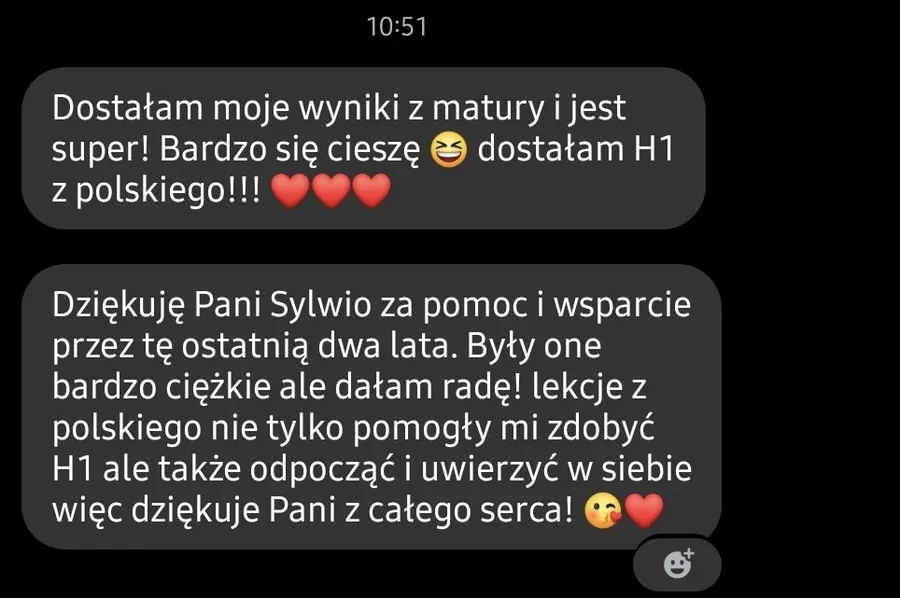
Dostalam moje wyniki z matury i jest super! Bardzo sie ciesze, dostalam H1 z polskiego. Dziekuje Pani Sylwio za pomoc i wsparcie przez te ostatnie dwa lata. Byly one bardzo ciezkie, ale dalam rade! Lekcje z polskiego nie tylko pomogly mi zdobyc H1, ale takze odpoczac i uwierzyc w siebie, wiec dziekuje Pani z calego serca!
I got my Leaving Cert results and they are brilliant. I am so happy, I got a H1 in Polish. Thank you Sylwia for the help and support over the last two years. They were very hard, but I got through them. The Polish lessons did not just help me get a H1, they also gave me a break and made me believe in myself, so thank you from the bottom of my heart.
LC Polish student -
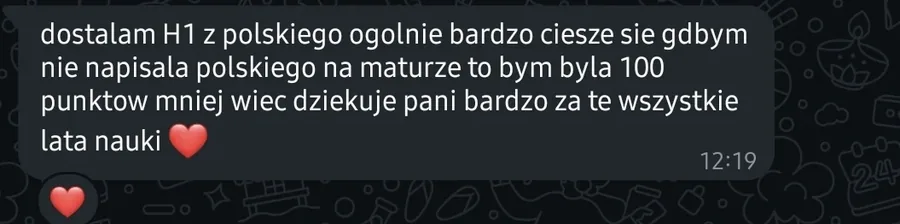
Dostalam H1 z polskiego, ogolnie bardzo ciesze sie. Gdybym nie napisala polskiego na maturze, to bym byla 100 punktow mniej, wiec dziekuje Pani bardzo za te wszystkie lata nauki.
I got a H1 in Polish and I am delighted. If I had not sat Polish in the Leaving Cert I would have been 100 points worse off, so thank you for all those years of teaching.
LC Polish student -
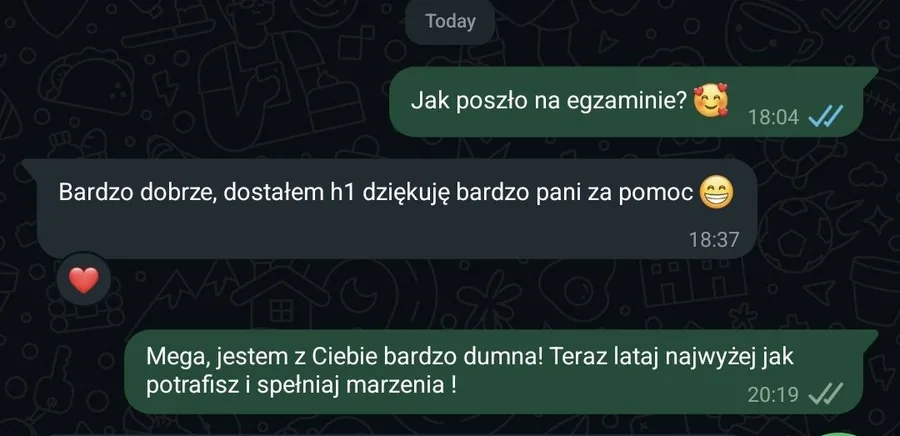
Bardzo dobrze, dostalem H1. Dziekuje bardzo Pani za pomoc.
It went really well, I got a H1. Thank you so much for the help.
LC Polish student, asked how the exam went -
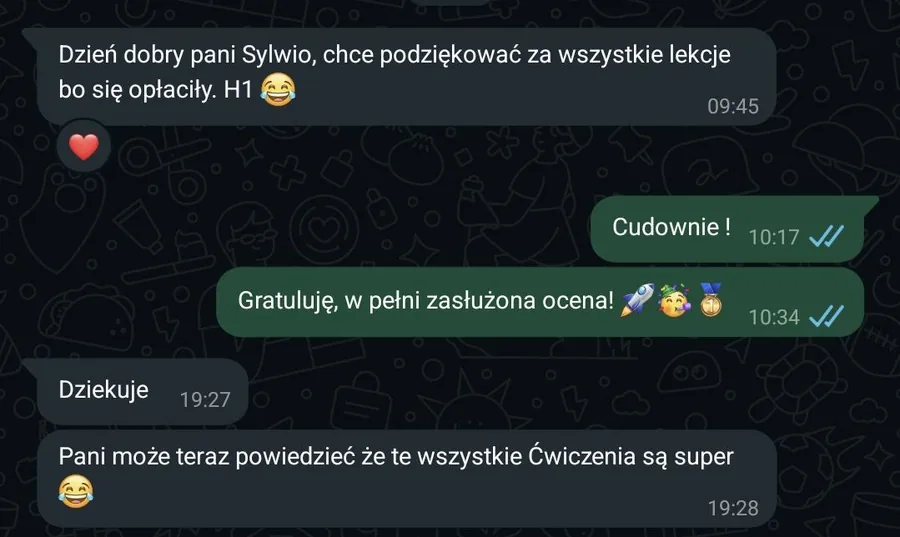
Dzien dobry Pani Sylwio, chce podziekowac za wszystkie lekcje, bo sie oplacily. H1. Pani moze teraz powiedziec, ze te wszystkie cwiczenia sa super.
Hello Sylwia, I want to thank you for all the lessons, because they paid off. H1. You can say now that all those exercises really are great.
LC Polish student -
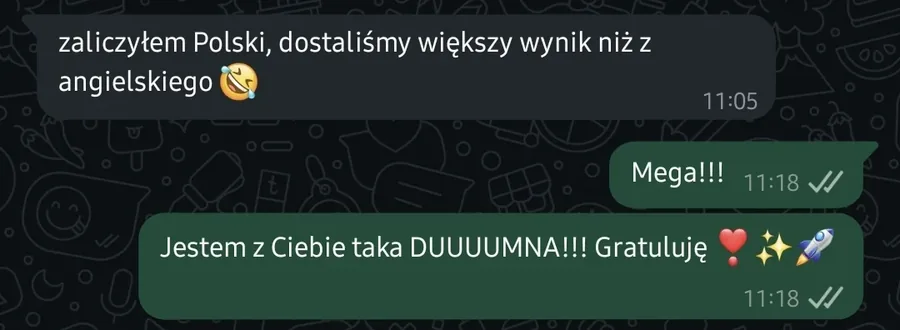
Zaliczylem polski, dostalismy wiekszy wynik niz z angielskiego.
I passed Polish, and we got a better result in it than in English.
LC Polish student -
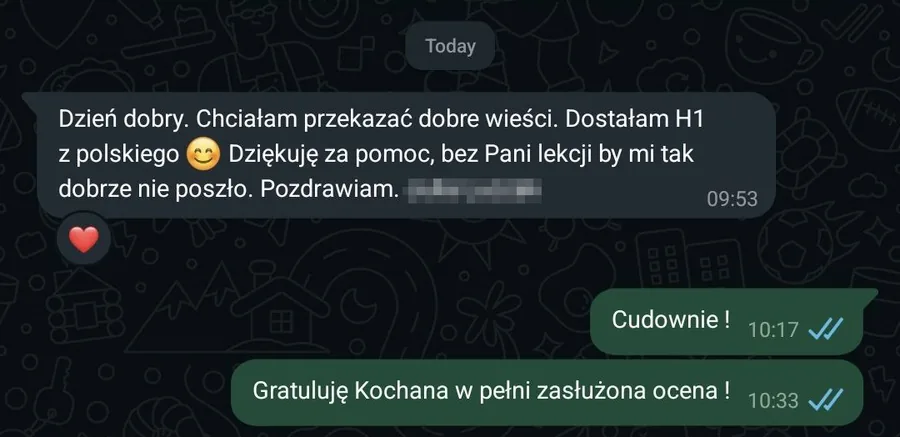
Dzien dobry. Chcialam przekazac dobre wiesci. Dostalam H1 z polskiego. Dziekuje za pomoc, bez Pani lekcji by mi tak dobrze nie poszlo. Pozdrawiam.
Hello. I wanted to pass on some good news. I got a H1 in Polish. Thank you for the help, it would not have gone half as well without your lessons.
LC Polish student

Practise between sessions
The past papers are free, and all of them are here
Every official Leaving Cert Polish paper from 2005 to 2026 lives in our archive: Higher and Ordinary Level, listening papers, the original audio and the marking schemes. Academy students work through them in the monthly paper review, but you do not need to be enrolled to use them.

Before you book
Questions students and parents ask first
What is the Polish Leaving Cert Academy?
It is a full-year course that prepares you for the Leaving Cert Polish exam, running from September to June alongside your school year. You join a small live group for a Monday evening lesson and a Saturday morning workshop, with a monthly exam paper review and a monthly 30-minute one-to-one booked separately. It is taught online by Sylwia Karolina Janiec, who has been teaching Polish in Ireland for fifteen years.
How much time does the Academy take each week?
Three hours of live teaching in an ordinary week: one hour on Monday evening and two hours on Saturday morning. Once a month the group works through an exam paper together, and you have a 30-minute one-to-one arranged separately. Homework sits on top of that, and how long it takes is up to you. The full year is on this page as a planner, so you can see every session date before you commit.
What level of Polish do I need for the Academy?
Around A2 and upwards. In practice that means you can hold a conversation at home and read simple Polish, even if you have never written an essay in it and never sat in a Polish classroom. Plenty of students arrive able to speak fluently but unable to spell, and that is exactly what the year is for. If you are unsure where you stand, book a free consultation and we will work it out together.
What happens if I miss a session?
Every live session is recorded and goes up on the platform, so you catch up in your own time. Between sessions you also have the self-paced Blitz and Go course, which covers the same ground in short units you can work through whenever it suits you.
How is my written work marked in the Academy?
Written work is reviewed using the published assessment requirements and marking guidance relevant to the task. You receive clear feedback on what is effective, what is incomplete and which language habit to work on in the next task. Once a month the whole group works through a real past paper together for the same reason.
What makes this different from ordinary grinds?
Grinds are usually an hour of grammar drill. This is a structured year with a syllabus, a portfolio, a mock exam and a marking scheme behind it, and culture running through all of it. You read Polish books, watch Polish films and argue about Polish history, because the students who read widely are the ones who write well under exam pressure. The pacing is shaped by Sylwia doctoral research in bilingual education.
Is the Academy right for me if I have never been to a Polish school?
Yes, and that describes a good share of the group. Speaking Polish at home and writing it to Leaving Cert standard are two different skills, and the second one is taught here from the ground up. Nobody is expected to arrive knowing the grammar terminology.
How do I join the Academy?
Book a free consultation. It is a short conversation about your level, your timetable and what you want out of the year, and you leave it knowing whether the Academy is the right fit. If Academy is the right fit, Sylwia will explain the current availability. Because the first cohort is formed, the next step may be a waiting-list place for a future group.
Next step
Have a look around first
- Free, no obligation Book a free consultation A short conversation about your level and your timetable, and an honest answer about whether the Academy fits.
- Your teacher Meet Sylwia Fifteen years teaching bilingual students in Ireland, and ongoing PhD research into bilingual learning.
- Free study resources Every past paper, 2005 to 2026 Higher and Ordinary Level papers, listening audio and marking schemes, straight from the SEC archive.
- The lighter option Leaving Cert Academy Lite The same year on one live hour a week: the Monday lesson on its own, without the Saturday workshop or the paper review.
Discuss a future Academy place with Sylwia
Book a free 15-minute consultation to discuss whether Academy matches the support you need and whether a future group may become available. Enrolment in any future group is covered by our terms and conditions.